
In this article
When it comes to patio umbrellas, shape is more than aesthetics — it directly affects how much shade you get, how the canopy fits your furniture, and how the umbrella feels in your outdoor space. Round umbrellas have long been the classic choice, but square canopies have earned serious ground for their modern look and superior coverage geometry. Understanding the practical differences between a round vs square patio umbrella will help you invest in the right shade solution the first time.
What to look for
- Canopy coverage relative to your table or seating footprint
- Frame material and wind resistance for your local climate
- Opening mechanism — tilt, crank, or push-button — for daily convenience
- Whether the umbrella will be used residentially or in a higher-traffic commercial setting
The Case for Round Patio Umbrellas
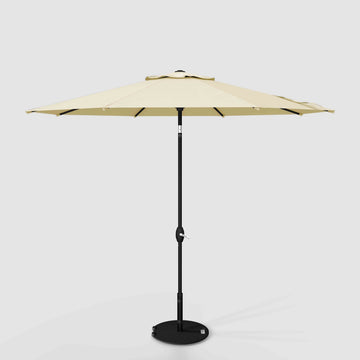
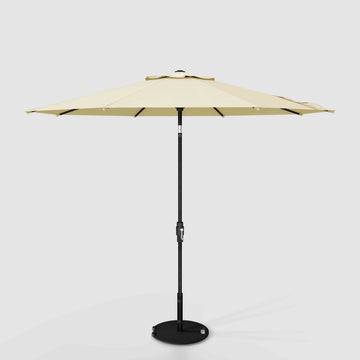
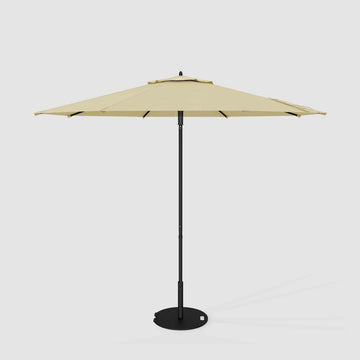
Round umbrellas are the time-tested standard for good reason. Their circular canopy casts a naturally centered pool of shade that radiates evenly in every direction from the pole — making them ideal for round or small square dining tables where guests are seated symmetrically around the center. Because shade moves with the sun's arc, a round canopy tends to keep at least some coverage over every seat throughout the day without requiring dramatic repositioning.
The soft, curved silhouette of a round umbrella also blends seamlessly with a wide range of outdoor décor styles, from casual garden settings to upscale resort-inspired patios. There's a reason you see round umbrellas everywhere from sidewalk cafés to backyard pergolas — they're familiar, approachable, and universally proportioned. Most standard outdoor furniture is designed with round umbrella pole holes in mind, so compatibility is rarely an issue.
Where round umbrellas can fall short is in covering rectangular or large sectional seating arrangements. A single round canopy tends to leave the ends of a long rectangular table exposed, especially as the sun shifts. If your seating layout is elongated or your space leans contemporary and architectural, you may find yourself wishing for something with a little more geometric edge — which is where square umbrellas come in.
Best for: Round dining tables, intimate seating areas, and traditional or garden-style patios


The Case for Square Patio Umbrellas
Square umbrellas offer a fundamentally different coverage geometry — four defined corners that align naturally with the edges of rectangular tables, sectional sofas, and structured outdoor living rooms. Instead of shade tapering off at the sides, a square canopy provides consistent, wall-to-wall coverage across its entire footprint. If you've ever watched the corners of your outdoor sofa bake in the afternoon sun despite a round umbrella overhead, a square canopy solves that problem directly.
From a design perspective, square umbrellas feel deliberately modern. Their clean lines echo architectural elements like pergola beams, raised planters, and linear outdoor furniture collections. For anyone who has invested in a cohesive contemporary patio aesthetic, introducing a square umbrella reinforces that intentionality rather than conflicting with it. They're particularly popular on urban terraces, commercial restaurant patios, and any setting where visual precision matters.
Square umbrellas also tend to perform well at larger scales. Because the canopy shape scales efficiently — each incremental inch of rib length adds coverage in two dimensions rather than one — large square umbrellas can shade a significant area without the visual bulk of an enormous round canopy. For hospitality venues or homeowners who entertain frequently, that means more guests comfortably shaded under a single, elegant structure.
Best for: Rectangular tables, modern or commercial patios, and large outdoor living areas


Coverage, Geometry & the Math of Shade
Here's a useful rule of thumb: your umbrella canopy should extend at least 24 inches beyond the edge of your table or seating on every side. For a 48-inch round table, that means you need a 96-inch (8-foot) round canopy minimum. For a 48-by-72-inch rectangular table, a round umbrella would need to be enormous to cover the short ends adequately — while an 8-by-10-foot square canopy handles it neatly. Thinking about coverage in these concrete dimensions prevents the common mistake of buying an umbrella that looks proportionate in a showroom but leaves half your guests squinting.
It's also worth noting that sun angle matters as much as canopy size. In the early morning and late afternoon, the sun is low on the horizon and shade from any canopy shifts dramatically. A tilting umbrella mechanism helps compensate for this — both round and square canopies benefit from tilt functionality, so don't let shape be the only factor you consider. Look for smooth tilt systems that let you redirect shade in seconds without leaving the table.
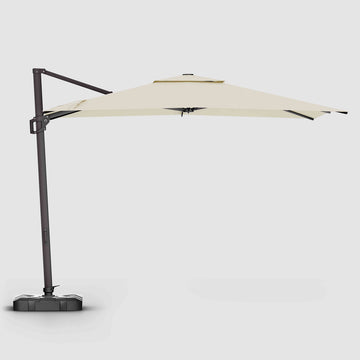
Finally, consider the pole placement relative to your table. Center-pole umbrellas — the most common style — work beautifully when the umbrella sits in a table's center hole. Cantilever or offset designs place the pole to the side entirely, which frees up table space and allows a wider canopy to hover over larger arrangements regardless of shape. If coverage footprint is your primary concern, an offset square umbrella may be the single most effective shade investment you can make.
Best for: Anyone calculating shade coverage for a specific table size or furniture layout


Style, Aesthetics & Outdoor Décor Matching
Shape communicates design intent before someone even sits down at your table. Round umbrellas naturally evoke relaxation, informality, and tradition — they feel at home in cottage gardens, Mediterranean-inspired courtyards, and family backyards. Their softness complements curved furniture, terracotta pots, and natural stone paving. If your outdoor space leans organic and layered, a round canopy will feel like it belongs there.
Square umbrellas, by contrast, signal structure and modernity. They look purposeful alongside composite decking, powder-coated steel furniture, and minimalist planters. For restaurant owners or homeowners who want their patio to have the polished, curated feel of a boutique hospitality space, square umbrellas deliver that visual upgrade immediately. The geometry also photographs cleanly, which matters for businesses showcasing their outdoor dining space.
Don't overlook frame and pole material as part of the aesthetic equation. Aluminum frames offer a sleek, contemporary look that pairs naturally with square canopies. Wood poles bring warmth and texture that tend to complement round canopies and more traditional furniture collections. The good news is that premium umbrella brands offer both materials across multiple canopy shapes, so you can find exactly the combination that suits your space without compromising on either style or durability.
Best for: Design-conscious homeowners and hospitality professionals curating a cohesive outdoor aesthetic


Commercial & High-Traffic Considerations
Restaurants, hotels, resorts, and event venues have fundamentally different umbrella needs than a residential backyard. Commercial umbrellas must withstand near-constant use, staff handling, harsh cleaning products, and exposure to UV rays across an entire season without fading, fraying, or failing. In these environments, frame construction and canopy fabric quality aren't preferences — they're operational necessities that affect both guest experience and bottom-line replacement costs.
Square commercial umbrellas have become increasingly dominant in hospitality settings, partly because they cover more of a standard 4-top or 6-top rectangular table and partly because their uniform visual grid creates a polished, branded look when multiple umbrellas are arranged side by side. A row of matching square canopies across a restaurant terrace reads as intentional design, while mismatched or improperly sized round canopies can make a space feel ad hoc.
For any commercial application, prioritize Sunbrella or Terylast canopy fabrics — both are engineered specifically for UV resistance, color retention, mold resistance, and longevity under continuous outdoor exposure. Pair them with heavy-gauge aluminum or fiberglass frames rated for wind resistance, and invest in weighted or in-ground bases rated for commercial use. The upfront cost is higher, but the total cost of ownership is dramatically lower than replacing budget umbrellas every season.
Best for: Restaurant patios, hotel pool decks, event venues, and any high-traffic commercial outdoor space
Frequently asked questions
Whether you land on a round or square canopy ultimately comes down to your table shape, your design aesthetic, and how much of your outdoor space you want to keep comfortably shaded. Get those fundamentals right, invest in quality fabric and frame construction, and your patio umbrella will deliver seasons of effortless, beautiful shade.
Keep reading
Related guides
 ComparisonsCantilever vs Market Umbrella: Which Is Right for You?
 ComparisonsBuying Guide: Tilt Umbrellas VS Market Umbrellas
 ComparisonsWhat Is the Difference between Terylast and Sunbrella Material for Patio Umbrellas?
Not sure which umbrella fits?
Our size guide does the measuring, and shade specialists answer in minutes on chat.

