


In this article
Choosing between a cantilever and a market umbrella is one of the first — and most important — decisions you'll make when outfitting an outdoor space. Both styles deliver serious shade, but they work very differently and shine in distinct situations. Understanding those differences up front will save you money, frustration, and the nagging feeling that you bought the wrong umbrella.
What to look for
- Table compatibility: Does your furniture have a center hole, or do you need a freestanding side-post solution?
- Coverage area: How many square feet of shade do you actually need, and will the canopy shape — round, square, or rectangular — work with your layout?
- Wind resistance: Look for fiberglass or aluminum frames with rated wind tolerance, especially in coastal or elevated settings.
- Ease of operation: Crank-lift, push-button, or pulley systems make a real difference in how often you'll actually use — and adjust — your umbrella.
What Is a Market Umbrella?
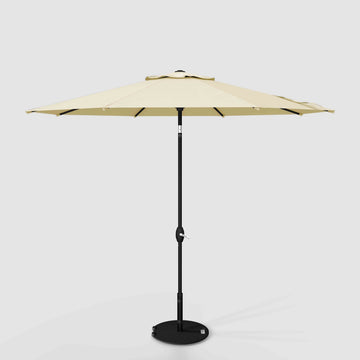
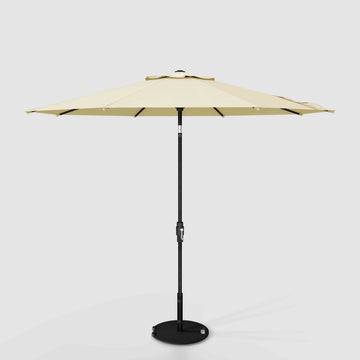
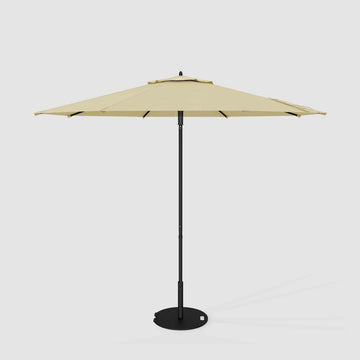
A market umbrella is the classic outdoor umbrella most people picture first: a straight center pole that passes through a hole in a table or mounts into a freestanding base, topped by a wide canopy held open by a simple hub-and-rib system. The design traces its roots to open-air market stalls in Europe, and it's remained popular for centuries because it's genuinely versatile, easy to understand, and available at almost every price point. At the premium end — where frames are aircraft-grade aluminum or fiberglass and canopies are woven from Sunbrella or Terylast fabric — a market umbrella becomes a long-term investment rather than a seasonal accessory.
What makes a quality market umbrella stand apart is the combination of canopy durability and frame engineering. Sunbrella and Terylast fabrics are solution-dyed, meaning the color is baked into each fiber rather than printed on the surface. That translates to dramatically slower fade rates and resistance to mold, mildew, and UV degradation. Pair that fabric with a wind-vented canopy design and a robust lifting mechanism — like a yacht-cleat or rise-and-click system — and you have a shade structure that performs in real-world conditions rather than just on a showroom floor.
Market umbrellas integrate seamlessly with dining sets that include a center-pole hole, and they're equally at home at a café, a resort pool deck, or a residential back patio. Because the pole runs straight through the center, the umbrella stays balanced and secure with a properly weighted base. They're also typically lighter and easier to move than cantilever rigs, which is a meaningful advantage if your shade needs shift throughout the day or across seasons.
Best for: Anyone with a center-hole dining table, a smaller patio, or a need for portability and classic style.


What Is a Cantilever Umbrella?
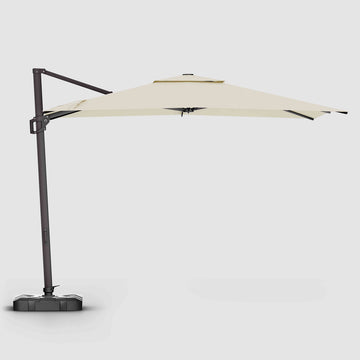
A cantilever umbrella — sometimes called an offset or side-post umbrella — positions the support pole to the side of the canopy rather than through the center. The canopy hangs out over the space below on an extended arm, leaving the area underneath completely clear of any obstruction. This engineering distinction sounds simple, but it fundamentally changes how and where the umbrella can be used. Seating arrangements no longer need to accommodate a center pole, and the canopy can often be rotated or tilted to follow the sun's arc across the sky.
The trade-off for that freedom is weight and footprint. Cantilever umbrellas require a much heavier base to counterbalance the offset canopy — often 150 to 200 pounds or more — and the base itself occupies meaningful floor space to one side of your seating area. The mechanical arm and rotating joint also introduce more moving parts than a center-pole design, which means quality of construction matters enormously. A cantilever built with fiberglass-reinforced ribs and a precision rotation collar will hold up through years of use; a budget version with plastic joints and thin aluminum will flex, wobble, and eventually fail at exactly the wrong moment.
Cantilevered shade is ideal for situations where a center pole would be either impractical or genuinely in the way — over a lounger by the pool, above a sectional sofa that has no table hole, or beside a hot tub. Because the canopy can be angled and rotated, a single well-positioned cantilever can provide effective shade from morning to late afternoon without repositioning the furniture beneath it. For commercial settings — hotel terraces, rooftop bars, spa decks — the open sightlines a cantilever provides are as much a design decision as a functional one.
Best for: Pool loungers, sectional sofas, hot tubs, or any setting where a center pole would block seating or sightlines.


Comparing Shade Coverage & Canopy Shape
Shade coverage is arguably the most practical metric when comparing cantilever vs market umbrella options, and canopy shape plays a bigger role than most shoppers expect. A round canopy casts an even, radiating circle of shade that works beautifully over circular tables or symmetrical lounger arrangements. A square or rectangular canopy aligns naturally with rectangular dining tables and modular sectional furniture, eliminating the awkward shaded-and-unshaded pockets you get when a round umbrella sits over a rectangular surface.
Market umbrellas are available in both round and square canopy profiles, giving you flexibility to match your furniture footprint. Cantilever umbrellas are also available in both shapes, but because the canopy is offset rather than centered, the alignment math is slightly different — you need to account for the rotation arc and the distance from the post when deciding where to anchor the base. In both categories, going larger than you think you need is almost always the right call. Shade contracts as the sun climbs higher, and a canopy that feels generous in the morning can feel stingy at noon.
Premium Sunbrella and Terylast canopies also influence perceived shade quality, not just durability. Solution-dyed fabrics block UV rays more effectively than lighter, cheaper alternatives, meaning the area under the canopy actually feels cooler rather than just visually shaded. For commercial operators who need to keep guests comfortable during peak afternoon hours, that UV-blocking performance is a real differentiator — and it's built into the fabric rather than added as an afterthought.
Best for: Shoppers prioritizing maximum UV protection and precise canopy-to-furniture alignment.


Wind Resistance & Frame Materials
Wind is the enemy of outdoor umbrellas, and it's the spec that separates a genuinely durable product from one that looks great in a catalog but folds — literally — at the first sign of a breeze. Both cantilever and market umbrellas can be engineered for wind resistance, but the construction details matter enormously. Look for frames made from marine-grade or powder-coated aluminum, or fiberglass ribs that flex under load rather than snapping. Wind vents built into the canopy allow gusts to pass through rather than lifting the entire structure like a sail.
Market umbrellas have a structural advantage in moderate wind because the center pole creates a direct, vertical load path straight into the base or table hole. With a properly weighted base, there's very little leverage for wind to exploit. Cantilever umbrellas, by contrast, present a larger moment arm to the wind — the offset canopy essentially acts as a lever trying to tip the base. High-quality cantilever bases compensate for this with significantly more ballast, and premium rotating collars lock the canopy angle firmly in place rather than letting it drift. If you live in a consistently windy environment, a market umbrella mounted in a table or heavy base is often the more stable everyday choice.
That said, both styles should be closed and secured when storms approach — no outdoor umbrella, regardless of price or construction, is designed to withstand sustained high-wind events. The real differentiator is how each style handles the everyday light-to-moderate breezes that are simply part of outdoor living. A fiberglass-ribbed canopy with a double-vent design will stay open comfortably in conditions that would send a flimsy aluminum frame rattling closed.
Best for: Coastal homes, elevated patios, or anyone in a region where afternoon wind is a regular part of life.


Ease of Use & Lifestyle Fit
The best outdoor umbrella is the one you'll actually open every day — and ease of operation has a huge influence on that. A cumbersome crank or a stiff pulley system creates enough friction in daily use that umbrellas get left closed more often than they should be. Modern lifting mechanisms like push-button systems, rise-and-click collars, and yacht-cleat locks are designed to eliminate that friction, letting you go from closed to fully open in a matter of seconds without tools or excessive effort.
For families with children or elderly users, a simple push-and-pop mechanism removes the coordination challenge entirely — you push a button and the canopy opens. For café operators or resort staff who open and close dozens of umbrellas per shift, a yacht-cleat system offers the speed and durability to handle high-volume use without wearing out. Cantilever umbrellas add the variable of canopy rotation and tilt adjustment, which adds utility but also adds steps — something to consider if your household will rarely take advantage of those adjustments versus needing reliable, no-fuss shade.
Lifestyle fit also encompasses aesthetics. Market umbrellas with wooden poles bring warmth and a crafted, artisanal feel that suits garden dining rooms and boutique hospitality environments. Aluminum frames read as cleaner and more contemporary, fitting seamlessly into modern outdoor furniture collections. Cantilever umbrellas, with their architectural side-post silhouette, tend to feel more designed and intentional — a statement piece as much as a shade structure. Neither choice is wrong; the right one is the one that fits how you actually live outdoors.
Best for: Households and commercial operators who want maximum ease of use built into a premium, long-lasting umbrella.

Frequently asked questions
Whether you land on the open-sightline freedom of a cantilever or the timeless practicality of a market umbrella, the right choice comes down to your furniture layout, your wind environment, and how you want to live outdoors. Invest in premium materials and a lifting mechanism you'll actually use, and your umbrella will reward you with years of effortless, beautiful shade.
Keep reading
Related guides
 ComparisonsBuying Guide: Tilt Umbrellas VS Market Umbrellas
 ComparisonsWhat Is the Difference between Terylast and Sunbrella Material for Patio Umbrellas?
 ComparisonsThe Difference Between Fiberglass and Aluminum Umbrella Ribs
Not sure which umbrella fits?
Our size guide does the measuring, and shade specialists answer in minutes on chat.