
Choosing the wrong size patio umbrella is one of the most common (and costly) outdoor-furniture mistakes homeowners and hospitality pros make. Too small and you're squinting into the sun; too large and the canopy overwhelms your space or catches wind like a sail. This guide walks you through every scenario — dining tables, loungers, commercial patios, and tight balconies — so you know exactly what size patio umbrella fits your life before you spend a dollar.
What to look for
- Table diameter rule: your umbrella canopy should extend at least 2 feet beyond each side of your table for real shade coverage
- Frame material matters for large canopies — wind-resistant aluminum or fiberglass holds shape and won't bend under a generous span
- Canopy shape (round vs. square vs. rectangular) should mirror your furniture footprint for even, gap-free coverage
- Offset (cantilever) vs. center-pole placement changes the effective shade zone, so measure where the sun hits, not just where the table sits
Small Tables & Bistro Settings (5–6 ft Canopy)
A 5- to 6-foot canopy is the sweet spot for bistro tables, two-person café sets, and compact balconies where every square foot counts. At this diameter, the umbrella shades two chairs comfortably without dominating the sightlines or creating a tripping hazard around a small space. The rule of thumb is to add roughly 4 feet to your table diameter — so a 28-inch bistro table pairs perfectly with a 6-foot canopy.
Compact umbrellas also work brilliantly beside a single lounge chair or as a stylish accent on a narrow side yard. Because the canopy is smaller, the pole and frame carry less wind load, making them inherently more stable in breezy conditions. Look for a sturdy center pole and a quality Sunbrella or Terylast fabric so the umbrella punches above its size in both durability and looks.
Don't mistake 'small' for 'cheap.' A well-built compact umbrella with a quality canopy will outlast a bargain oversized one that flaps, fades, and wobbles within a season. Investing in craftsmanship at any size pays off in years of low-maintenance shade.
Best for: Bistro tables, couples' dining sets, narrow balconies, and single lounge chairs

Standard Dining Tables (7–9 ft Canopy)
The 7-to-9-foot range is the most popular canopy size for good reason: it covers the widest variety of residential dining situations. A 48-inch round table seats four comfortably and calls for roughly an 8-foot umbrella; a 60-inch round table for six bumps that up to a 9-footer. The extra overhang on each side is what actually shades seated guests — their shoulders and arms are what feel the sun, not the tabletop.
When shopping in this range, pay close attention to frame construction. Aluminum poles with fiberglass ribs flex slightly in wind without snapping, which is critical at spans where sail area becomes meaningful. A wobbly frame at 8 feet doesn't just look bad — it shortens canopy life dramatically as the fabric stresses at every gust. Midtown Umbrellas' wind-resistant frames are built specifically to handle this size range without sacrificing elegance.
Center-pole models in this size are classic and time-tested, but make sure your dining table has a pre-drilled hole or that you're pairing it with a compatible base. If your table is solid (no center hole), a cantilever offset design frees the table surface entirely and eliminates the pole-dodging dance that frustrates diners.
Best for: 4- to 8-seat residential dining tables, standard patio furniture sets


Large Dining & Lounge Areas (10–13 ft Canopy)
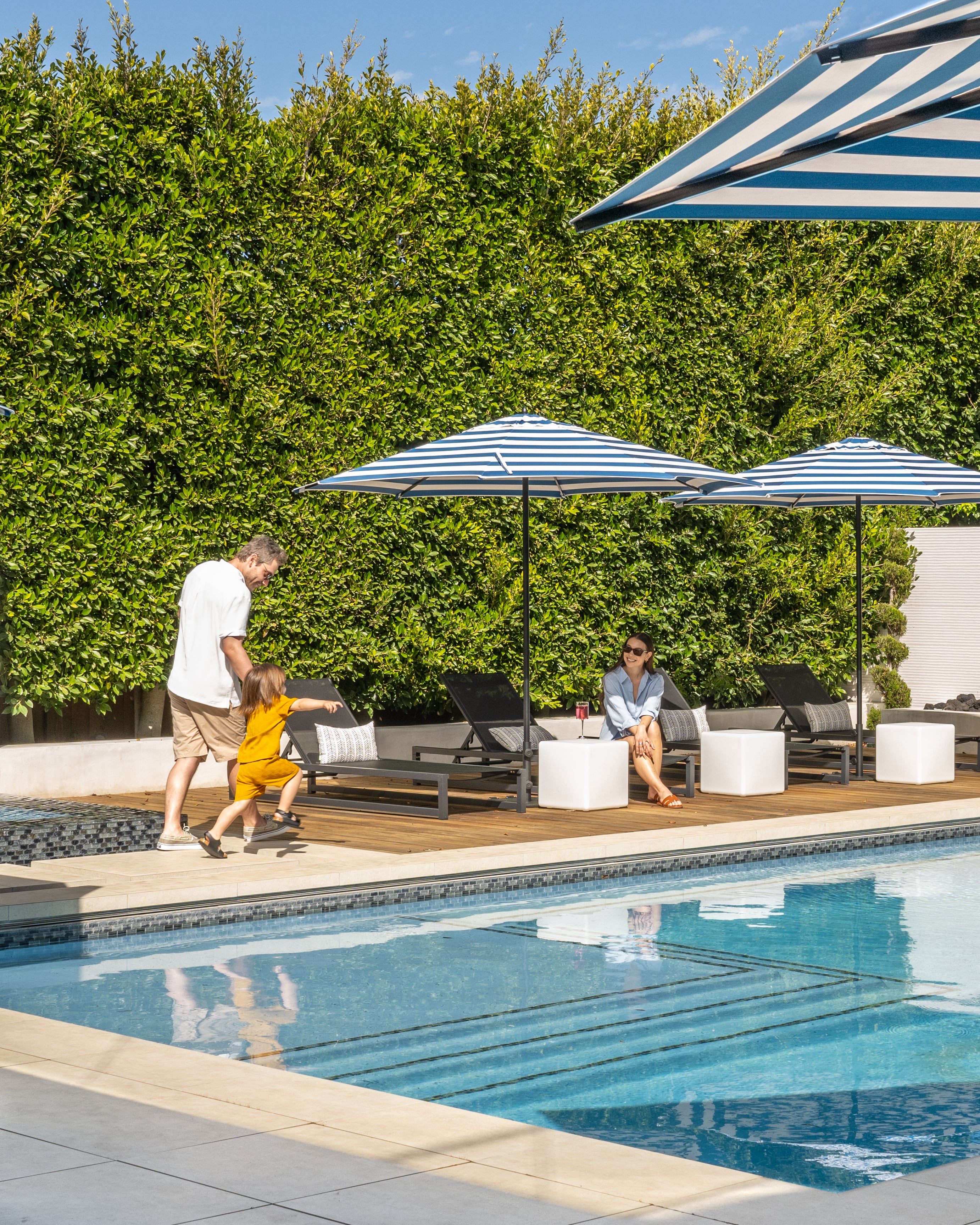
Once you're shading a 10-person dining table, a sprawling sectional sofa, or a poolside lounger cluster, you're in the 10-to-13-foot canopy territory. At this scale, shade coverage is genuinely generous — a 13-foot canopy casts roughly 130 square feet of shadow at peak sun angles, enough to cover multiple pieces of furniture simultaneously. This is also where frame engineering becomes non-negotiable; a cheap frame at this span is a liability.
Large canopies excel at unified outdoor living rooms. Rather than scattering multiple smaller umbrellas (which creates a cluttered, patchwork look), a single well-placed large canopy anchors the space visually and functionally. Pair it with a heavy, purpose-built base — at least 50 lbs for a freestanding setup in this range — and consider whether a weighted or in-ground mount better suits your patio surface.
LED-integrated options are especially compelling at larger sizes because the canopy overhead becomes a genuine architectural feature of the space. Lighting integrated into a wide canopy creates an evenly lit outdoor room rather than a single spotlight, which is ideal for entertaining. Think of a large canopy less as an umbrella and more as a portable outdoor ceiling.
Best for: Large sectionals, extended dining tables, poolside lounge clusters, outdoor living rooms


Square & Rectangular Spaces (Square Canopy Options)
Round canopies are the default, but they're a poor match for rectangular dining sets and linear outdoor kitchens. A round 9-footer hung over a 36x72-inch rectangular table leaves the short ends of the table exposed and unshaded — exactly where the afternoon sun tends to hit. Square and rectangular canopies solve this by matching the geometry of the furniture beneath them, delivering edge-to-edge coverage without wasted shade in the corners.
The general sizing principle still applies: add roughly 2 feet of canopy overhang on each side of your table. So a 36x72-inch table (3x6 ft) ideally needs a canopy approximately 7x10 feet. A square table, say 48x48 inches, pairs naturally with a square canopy in the 8-to-9-foot range. Getting the geometry right is what separates a professionally styled patio from one that looks like an afterthought.
Square and rectangular frames also tend to align beautifully with pergola-style architecture, modern decking, and linear planter arrangements. If your outdoor aesthetic leans contemporary — clean lines, geometric planters, linear tile — a square canopy reads as intentional design rather than a utilitarian sun-blocker.
Best for: Rectangular dining sets, outdoor kitchen bars, modern linear patio layouts

Commercial & Hospitality Settings
Restaurant terraces, hotel pool decks, and rooftop bars operate under entirely different demands than a residential backyard. Commercial umbrellas need to withstand daily setup and breakdown, handle higher wind exposure (especially at rooftop level), and look consistently polished through heavy seasons of use. This is where commercial-grade frames — heavy-wall aluminum, marine-grade hardware, industrial base systems — earn every extra dollar.
Commercial sizing typically starts at 10 feet and can run to 13 feet or larger for stand-alone market-style installations. For café-style seating where four chairs surround a 30-inch table, a 7.5-to-9-foot canopy per table is standard in the hospitality industry, ensuring guests feel sheltered rather than merely shaded. When spacing multiple umbrellas across a terrace, allow at least 18 inches between canopy edges to prevent canopy contact in wind.
Canopy fabric selection is even more consequential in commercial settings. Sunbrella fabrics are solution-dyed acrylic, meaning the color goes through the fiber rather than sitting on top — they resist the bleaching effect of commercial cleaners and daily sun exposure far longer than polyester alternatives. For a high-turnover hospitality environment, a Sunbrella or Terylast canopy is genuinely a cost-saving choice over a multi-year horizon.
Best for: Restaurant terraces, hotel pool decks, café seating, rooftop bars, event venues
