
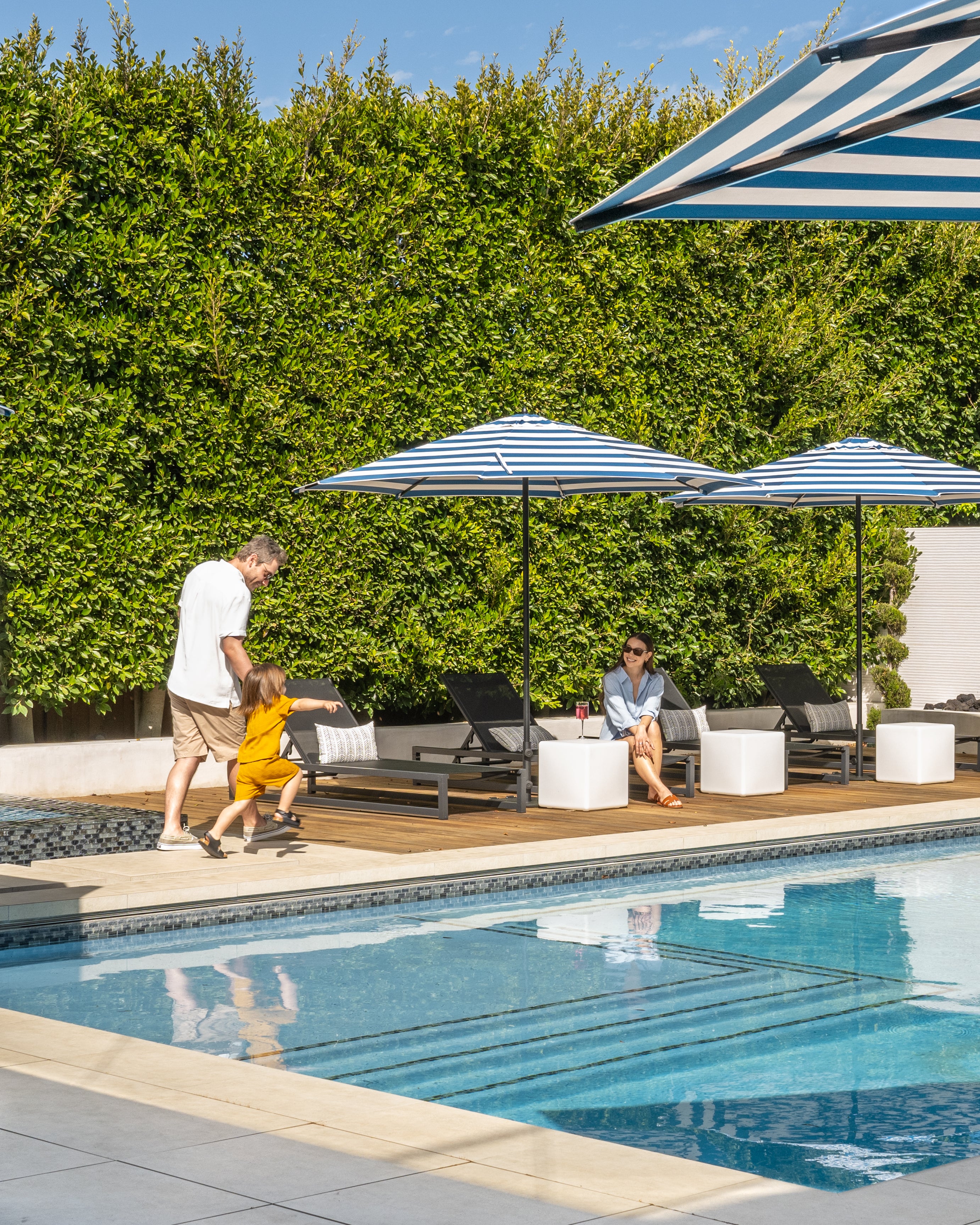
A great market umbrella does more than block the sun — it anchors your outdoor space, extends the hours you spend outside, and holds up through wind, rain, and years of use. But with so many options on the market, knowing what actually matters (frame material, canopy fabric, opening mechanism) can make the difference between a purchase you love and one you replace next season. This guide breaks down the best market umbrellas by use case, so you can shop with confidence and find the right fit for your patio, deck, or commercial venue.
What to look for
- Frame material matters: aluminum resists rust while fiberglass flexes in wind rather than snapping — look for reinforced ribs on larger canopies
- Canopy fabric is non-negotiable: solution-dyed acrylics like Sunbrella and Terylast resist fading, mold, and UV damage far longer than polyester alternatives
- Opening mechanisms range from simple push-button lifts to crank-free auto-tilt systems — choose based on how often and how easily you need to operate the umbrella
- Size and pole diameter should match your base: a 9-ft canopy on a too-light base is a liability on a breezy afternoon
Best Overall Market Umbrella for Home Patios
When most homeowners picture a market umbrella, they're imagining something that looks elegant, opens effortlessly, and doesn't require a weekend of assembly. The best home patio umbrellas nail that balance between everyday convenience and long-term durability. You want a canopy fabric that won't bleach out after a single summer and a frame that doesn't wobble the moment a breeze rolls through.
The Push and Pop™ earns its name by making shade completely effortless — a single push deploys the canopy, and a single pop brings it back down. No cranks, no tangled pulleys, just clean reliable operation every time. Paired with a solution-dyed canopy that shrugs off UV and moisture, it's the kind of umbrella you stop thinking about and just enjoy. The Wooden™ takes a different approach, trading modern minimalism for the warm, timeless look of a hardwood pole and frame. If your patio furniture leans classic or natural, the rich grain of a wooden-frame umbrella integrates beautifully — and Midtown's version backs that aesthetic with a genuinely weather-resistant construction.
For homeowners who want something that feels considered rather than commodity, these two umbrellas represent the high end of residential market umbrellas. Neither is overbuilt for a casual backyard, but both are built well enough that you won't be replacing them when fashions change.
Best for: Homeowners who want a reliable, attractive market umbrella for everyday residential use


Best Market Umbrella for Wind-Prone Spaces
Wind is the silent killer of cheap patio umbrellas. A canopy that catches a gust like a sail will stress every joint in the frame, and most budget umbrellas simply aren't engineered to flex and recover. If your patio faces prevailing winds, sits on an elevated deck, or is exposed on a rooftop terrace, wind resistance should be your single biggest specification when shopping for a market umbrella.
Fiberglass-ribbed frames are the gold standard here — unlike aluminum ribs, fiberglass bends under wind load and springs back without fatiguing over time. Look also for vented canopies, which allow air to flow through the top rather than building pressure underneath. The combination of a vented top and flexible fiberglass ribs dramatically reduces the chance of inversion or frame failure during a sudden gust.
The Slight™ is purpose-built for exactly this challenge. Its low-profile, aerodynamically considered design reduces wind resistance at the canopy level while its frame construction is engineered to flex rather than fight a strong breeze. For patios where the wind picks up every afternoon, the Slight isn't a compromise — it's genuinely the smarter choice.
Best for: Elevated decks, rooftop terraces, and any outdoor space that regularly experiences wind

Best Easy-Open Market Umbrella for Convenience
Not everyone wants to think about their umbrella. For busy households, rental properties, or anyone who just wants shade without fuss, the opening and closing mechanism is one of the most underrated features in a market umbrella. A crank that sticks, a cord that frays, or a tilt that won't lock properly quickly turns a lovely umbrella into a daily frustration.
Auto-open systems have come a long way, and the best ones now combine speed with satisfying precision. The Rise and Click™ is the clearest example of this done right — the umbrella rises smoothly and clicks securely into position without any fiddling. There's a confidence to the mechanism that you feel the first time you use it, and it doesn't degrade over seasons the way cheaper pulley systems do. For households with multiple people using the umbrella — including kids or guests who aren't reading the instructions — a foolproof open-and-lock system is genuinely worth specifying.
If you manage a vacation rental or simply want an umbrella that anyone can operate without asking how, the Rise and Click™ removes every point of friction from the experience. It's the kind of feature that sounds minor until you've fought with a bad crank on a sunny afternoon.
Best for: Busy households, rental properties, and anyone prioritizing daily ease of use

Best Commercial-Grade Market Umbrella
Commercial umbrellas live a harder life than residential ones. A restaurant patio umbrella might be opened and closed a dozen times a day, rained on, baked in direct sun for eight-hour stretches, and expected to still look sharp for guests on year three. That's a fundamentally different performance requirement than a backyard umbrella used on weekends, and it demands a fundamentally different product specification.
The Supreme Market™ is Midtown's answer to commercial-grade performance. Built with heavier-duty frame components, industrial-quality pivot points, and a canopy fabric engineered for repeated UV exposure without color shift, it's designed to meet the demands of hospitality environments where appearance and longevity are both non-negotiable. The Yacht Cleat adds another dimension to commercial applications — its distinctive cleat-style securing mechanism provides a nautical-inspired aesthetic that resonates in coastal and marina-adjacent venues, while its structural engineering is every bit as serious as its looks suggest.
For restaurant owners, hotel operators, and event venue managers, investing in commercial-grade umbrellas isn't a luxury — it's a total cost of ownership decision. An umbrella that lasts three to four seasons in a commercial setting versus one that fails in the first year pays for its premium many times over in replacement costs, not to mention the guest experience implications of a faded or broken canopy mid-service.
Best for: Restaurants, hotels, event venues, and any high-use commercial outdoor space


How to Choose the Right Market Umbrella Size and Base
Canopy diameter is one of the first specs buyers look at, but it's often misunderstood. The rule of thumb is that your umbrella canopy should extend roughly two feet beyond the edge of the furniture it's shading on each side — so a 48-inch round dining table typically calls for a 9-foot umbrella at minimum. Go too small and the people sitting at the edges of your table get no benefit; go too large without an appropriately weighted base and you've created a wind hazard.
Base weight is directly proportional to canopy size and wind exposure. A 9-foot umbrella in a calm sheltered courtyard can be adequately secured by a 50-pound base; that same umbrella on a breezy elevated deck may need 75 pounds or more. In-ground mount systems and pole-sleeve bases anchored through a table are inherently more stable than freestanding weighted bases, so factor your installation context into the size decision. Most manufacturers — including Midtown — publish recommended base weights for each umbrella, and it's worth following those specifications rather than guessing.
Pole diameter also matters for compatibility. Most residential market umbrellas use a 1.5-inch to 2-inch pole; commercial models sometimes run larger. Always check that your chosen base is rated for the pole diameter of your umbrella before purchasing, particularly if you're buying a base separately. A mismatched fit creates wobble that no amount of tightening will fix permanently.
Best for: Anyone starting from scratch or upgrading an existing setup who needs to match umbrella size to space and base
Market Umbrella Canopy Fabrics Explained: Sunbrella vs. Terylast
The canopy fabric you choose determines not just how your umbrella looks on day one, but how it looks on day five hundred. In the outdoor furniture world, not all fabrics are created equal — the gap between a solution-dyed acrylic and a coated polyester widens dramatically after a single season of real-world UV exposure, moisture cycling, and the occasional mildew challenge.
Sunbrella is the category benchmark for a reason. Its solution-dyed acrylic fibers are colored all the way through, meaning UV rays have nowhere to bleach — the color is in the fiber itself, not applied as a surface coating. It's also highly breathable, which resists the trapped moisture that leads to mildew. Terylast is a comparable solution-dyed acrylic that offers similar UV and weather performance with its own range of textures and color expressions. Both fabrics are used across Midtown's premium umbrella line and represent a meaningful upgrade over polyester alternatives in longevity, color retention, and overall appearance over time.
When comparing market umbrellas, check whether the canopy is described as solution-dyed — this is the detail that separates a five-year canopy from a two-year one. Both Sunbrella and Terylast canopies can be cleaned with mild soap and water, are resistant to most common outdoor stains, and maintain their appearance through repeated weather cycles. If you're investing in a quality frame, match it with a quality fabric — the two work together to determine the total life of your umbrella.
Best for: Shoppers deciding between fabric options and wanting to understand what drives long-term canopy performance
